Cost to Demolish Concrete: Factors That Can Affect Your Quote
Concrete demolition is a necessary first step in many commercial construction projects—especially when dealing with cracked, damaged, or outdated slabs. Whether you’re resurfacing pavement or preparing for a full rebuild, removing the existing concrete is often unavoidable. When pursuing this route, it’s essential to account for the costs when setting your renovation budget.
In this post, we’ll discuss the average price of concrete demolition. Additionally, we’ll explore what factors might impact your quote and final bill. For a faster, more precise estimate tailored to your Southern California project,
call
TMC
Engineering.
Our experienced technicians provide accurate quotes for concrete demolition and removal. We are committed to delivering every asphalt and concrete project with the highest standards of quality, professionalism, and timeliness.
If you’re outside Southern California or still in the early stages of budgeting for your next renovation, continue reading to gain a clear understanding of concrete demolition cost estimates.
Cost to Demolish Concrete: Factors That Can Affect Your Quote
When it comes to construction projects, we often focus on what’s being built rather than what needs to be removed. However, demolition and removal are essential parts of the process. It’s vital to account for them in your budget from the start.
In this comprehensive guide, we’ll cover the fundamentals of concrete demolition and outline the typical costs involved. In addition to this, we will also explore factors that can impact both the price and process.
Here’s what you need to know about concrete demolition and its projected costs:
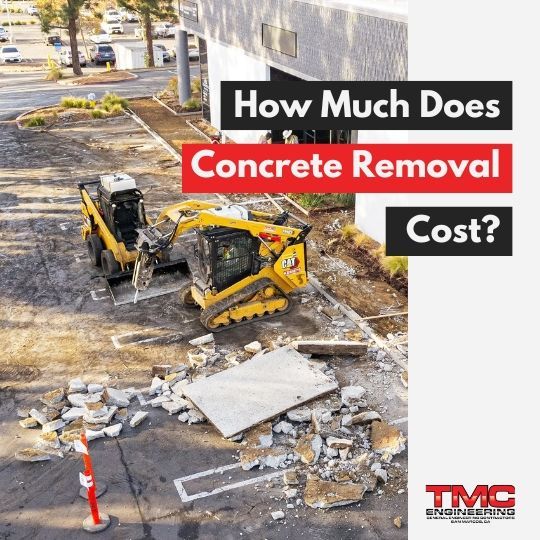
What Is Concrete Demolition?
Concrete demolition involves the removal of existing concrete surfaces and structures. The process typically includes breaking the concrete, clearing debris, and preparing the site for the next phase of construction.
There are several reasons why concrete demolition may be necessary, depending on the condition of the existing structure and the project goals. In most cases, the concrete might be structurally compromised. As a result, the foundation can become hazardous, posing safety risks that may lead to costly fines and regulatory violations.
Other times, demolition is necessary to remove outdated or poorly installed concrete that no longer meets code or performance standards. Additionally, property owners may choose to demolish existing concrete as part of a larger renovation or expansion project.
Regardless of the reason, proper demolition ensures a clean, stable foundation for future phases of commercial construction.
How Much Does Concrete Removal Cost?
Professional concrete removal costs range from $2 to $7 per square foot. Disposal is an additional fee, ranging between $51 to $100 per ton. However, weight and square feet aren’t the only factors that impact project cost. Below, we will list common factors that affect the final cost of concrete demolition.
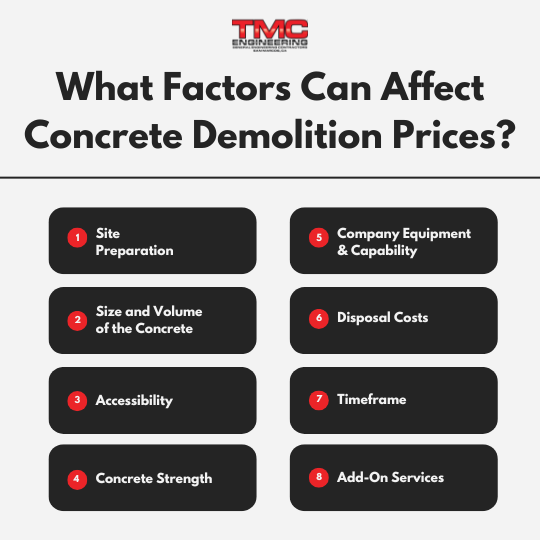
What Factors Can Affect Concrete Demolition Prices?
Site Preparation
Preparing a site for concrete demolition involves more than just breaking up the surface. Clearing obstacles, disconnecting utilities, shoring, trenching, and other preparatory tasks all require manpower, specialized equipment, and time. In addition, commercial sites often require multiple permits and potential environmental assessments before work can begin, all of which add to the total project cost.
Size and Volume of the Concrete
Not all concrete projects require the same effort and disposal operations. If a contractor is simply tasked with removing a concrete patio, the slab is typically shallow and not heavily reinforced. As a result, it’s generally easier and more cost-effective to remove. In contrast, reinforced concrete loading docks or even commercial parking lots can be as thick as 18 inches.
The size, thickness, and density of concrete slabs require different equipment and removal measures. As concrete gets thicker, more effort is needed to remove it, and the amount of debris for disposal increases—driving up the overall cost.
Accessibility
The location of the concrete can significantly impact demolition costs. Surfaces or structures in hard-to-reach areas complicate logistics. As a result, this process often requires specialized equipment capable of maneuvering in tight spaces. If the equipment cannot safely operate in the area, manual breaking and hauling will be necessary.
Obstructions such as utility lines, adjacent buildings, or landscaping may necessitate careful, precise demolition techniques. These challenges increase labor costs, extend project timelines, and add to overall expenses.
Concrete Strength
Concrete varies widely in compressive strength, which affects how difficult it is to remove. Slabs with higher compressive strength are denser and tougher, a common feature of commercial or industrial properties. Removing these surfaces often requires the use of hydraulic breakers, excavators, concrete saws, and skilled operators.
Reinforcement with rebar or wire mesh adds further complexity, demanding more time, labor, and specialized equipment. In short, the stronger and more reinforced the concrete, the higher the costs and effort involved in demolition.
Company Equipment and Capability
Not all concrete demolition contractors have access to the heavy machinery required for large-scale concrete demolition. Tools for concrete removal, such as hydraulic breakers, hoe-rams, concrete crushers, bulldozers, and hauling vehicles, are essential for completing commercial projects efficiently and on schedule.
Smaller concrete companies or DIY concrete removal efforts may only have jackhammers, hand tools, or basic saws. This can increase the project duration and the effort required, ultimately driving up costs. Partnering with experienced commercial contractors like TMC Engineering ensures the right equipment and expertise are applied from start to finish.
Disposal Costs
Concrete demolition doesn’t end once the slabs are broken. Contractors must separate and sort debris. Then, they’ll load it into dump trucks, roll-off containers, or skid steers, and transport the material to a transfer station or recycling facility.
Disposal involves labor, time, equipment, and fees. Most facilities charge by weight. Additionally, because concrete is heavy, this can be a significant contributor to the total project cost.
Timeframe
The urgency of your project can also influence costs. Tight schedules or last-minute timelines may require overtime, additional labor, and extra equipment, driving up expenses. If you can allow flexibility in timing, contractors may be able to complete the work more efficiently and at a lower cost.
Add-On Services
Concrete demolition is often just one step in a larger project. You may also need services such as site grading, soil stabilization, drainage preparation, or pouring new concrete. Including these potential services in your initial estimate ensures you have a more accurate view of total costs and avoids unexpected charges later.
Concrete demolition cost varies depending on project specifications.
Removing concrete can be more complicated than many anticipate. Average costs may be higher than expected if you aren’t aware of all the factors involved. To ensure you get both the best price and the highest quality work, it’s wise to consult multiple contractors.
If you’re in Southern California, you can skip the guesswork.
Contact TMC Engineering to discuss your next construction project and receive an accurate, expert quote for concrete demolition and removal. Our team is committed to handling every concrete and asphalt project with the highest standards of quality, professionalism, and timeliness.